
The complete guide
Choosing a Travertine Vanity Tray, A Practical Buyer's Guide
The bench problem
Most bathroom and bedroom clutter is not really clutter. It is four or five things you use every single day that have nowhere specific to live. A perfume bottle, a hand cream, a ring you take off before washing up, a watch, maybe a hair tie. Individually they are fine. Spread across a vanity they read as mess, and worse, you lose track of them.
A small tray fixes this faster than any storage system. It draws a line around the things that are allowed to sit out. Inside the line is deliberate. Outside the line is clutter. That sounds like a silly psychological trick, but it genuinely works, and it is why a vanity organiser tray tends to be the first thing stylists put on a bench.
The question is which tray. Plastic looks cheap in about a week. Timber marks when it gets wet. Mirror shows every fingerprint. Natural stone sits in a sweet spot, and travertine in particular has a softness that polished marble does not.
What travertine actually is
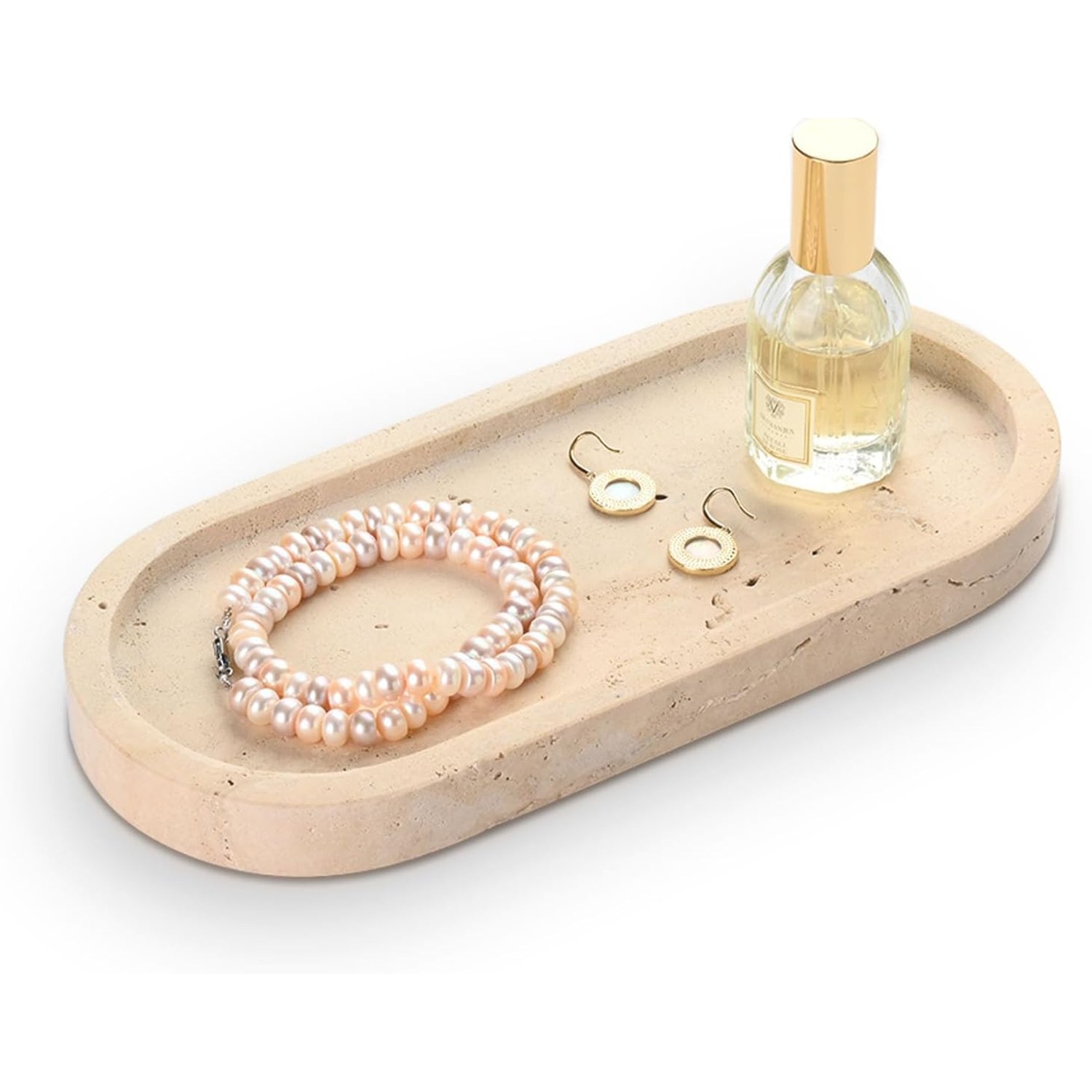
Travertine forms around mineral springs, where calcium carbonate settles out of the water over a long stretch of time. As it builds up, gas escapes and leaves small voids behind. Those are the pores you can see on the surface of this tray.
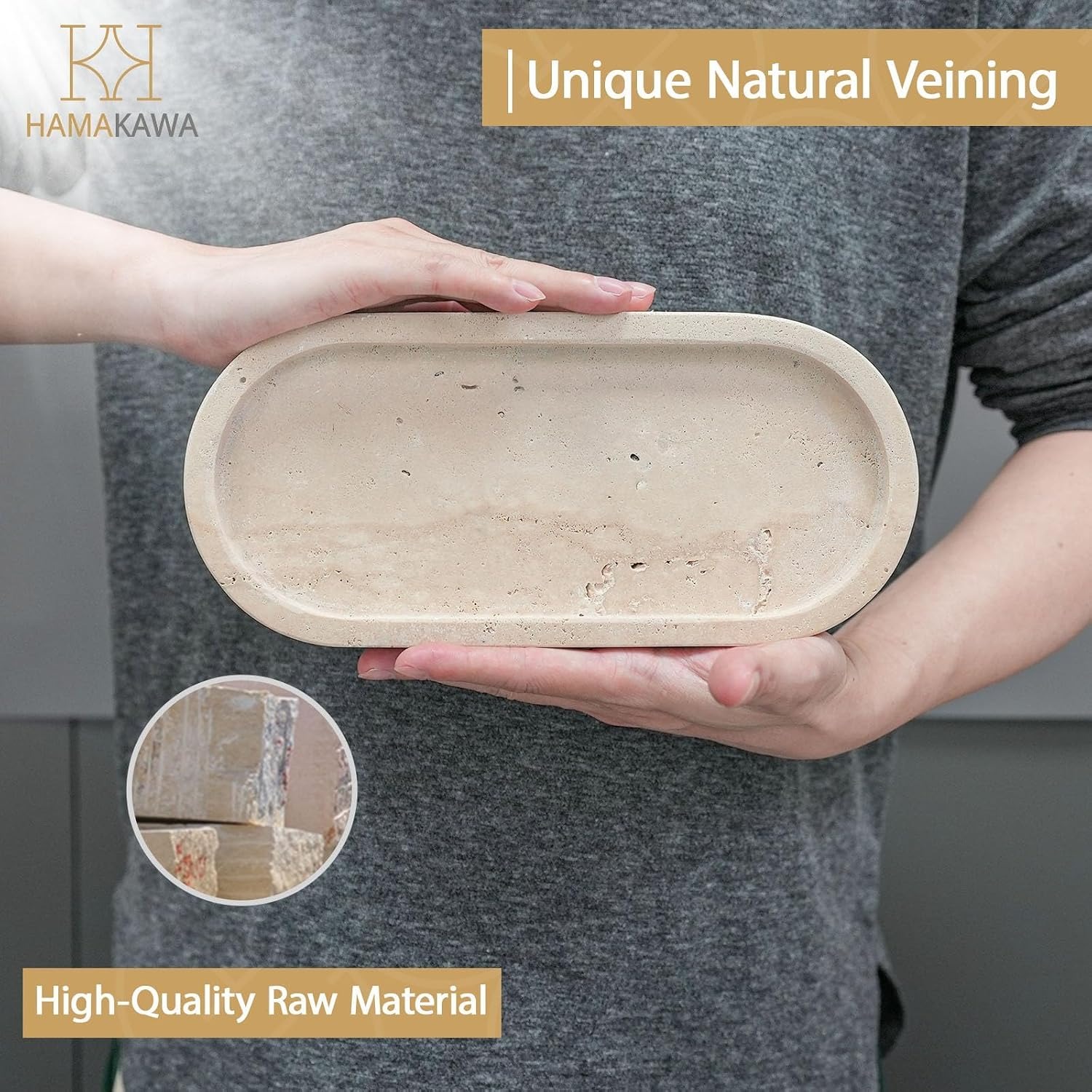
That porosity is the whole character of the stone. It makes the surface matte rather than glassy, and it gives the beige a depth that printed or moulded lookalikes never manage. Run a finger across it and you can feel the texture. It is cool to the touch, slightly uneven, clearly a thing dug out of the ground rather than poured into a mould.
It also means no two pieces match. One tray might be pale and almost uniform. The next might carry a darker band running through it or a cluster of larger pores at one end. If you need matching decor, that variation can be frustrating. If you like the idea that your tray is specifically yours, it is the best part.
The size question
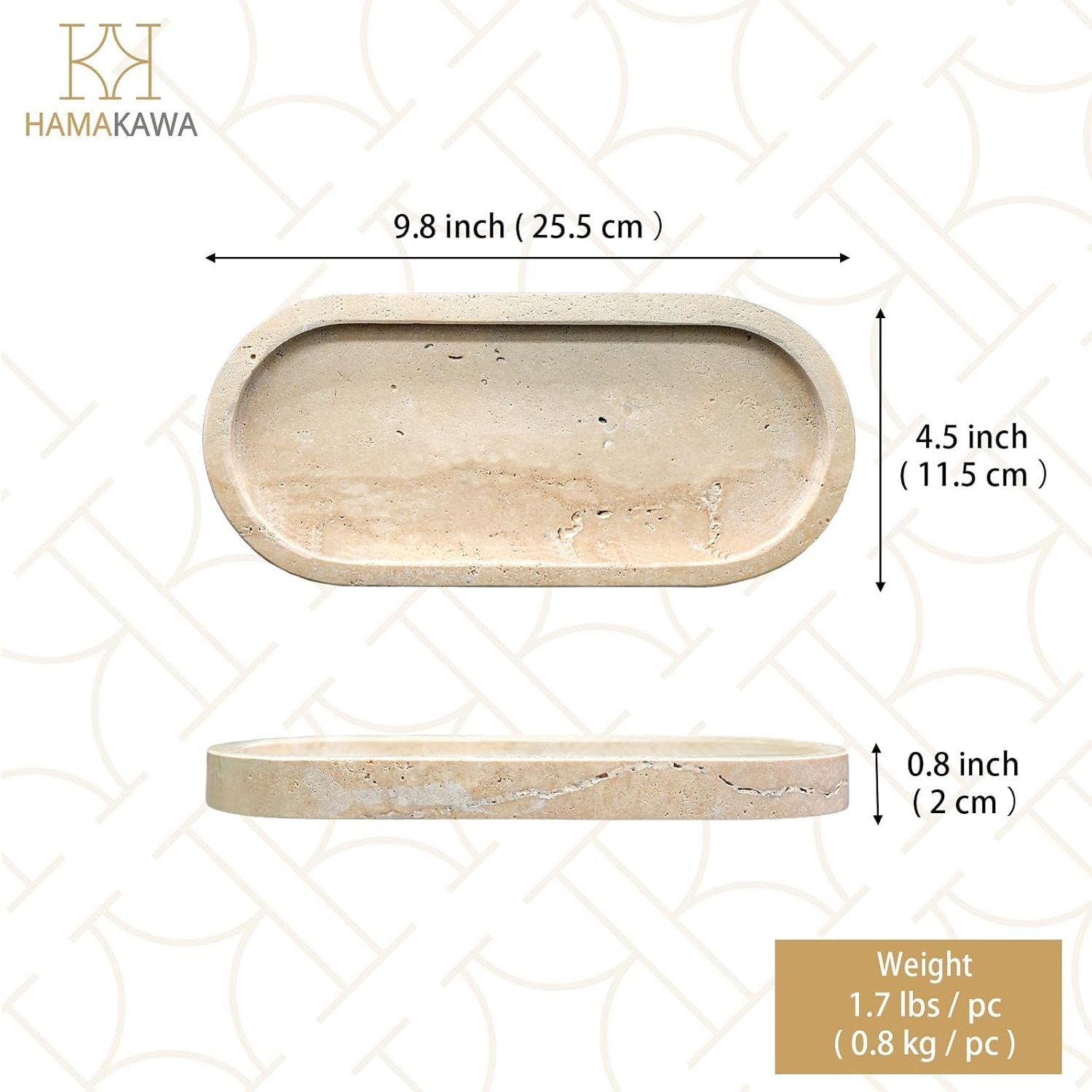
This one measures 25 cm long by 11.5 cm wide, with a 2 cm height. In inches that is 9.8 by 4.5 by 0.8.
Narrow ovals like this are more useful than they look. On a typical bathroom vanity you have a strip of bench between the basin and the wall, and a wide square tray will not fit there without crowding the tap. A 11.5 cm width slips in neatly. It holds two or three bottles in a row, or a soap dish with a small candle beside it.
On a dresser, the same proportions work along the front edge of the surface, leaving the back clear for a mirror or lamp. In an entryway it sits on a narrow console without hanging over the sides.
Where it is less suited is as a serving tray or a big coffee table catchall. For that you want something closer to 35 or 40 cm. Know what job you are hiring it for.
Weight and stability
At 0.8 kg this is a heavy little object for its size, and that is intentional. Lightweight trays get nudged out of position every time you reach for something, and they travel slowly toward the edge of the bench until one day they do not.
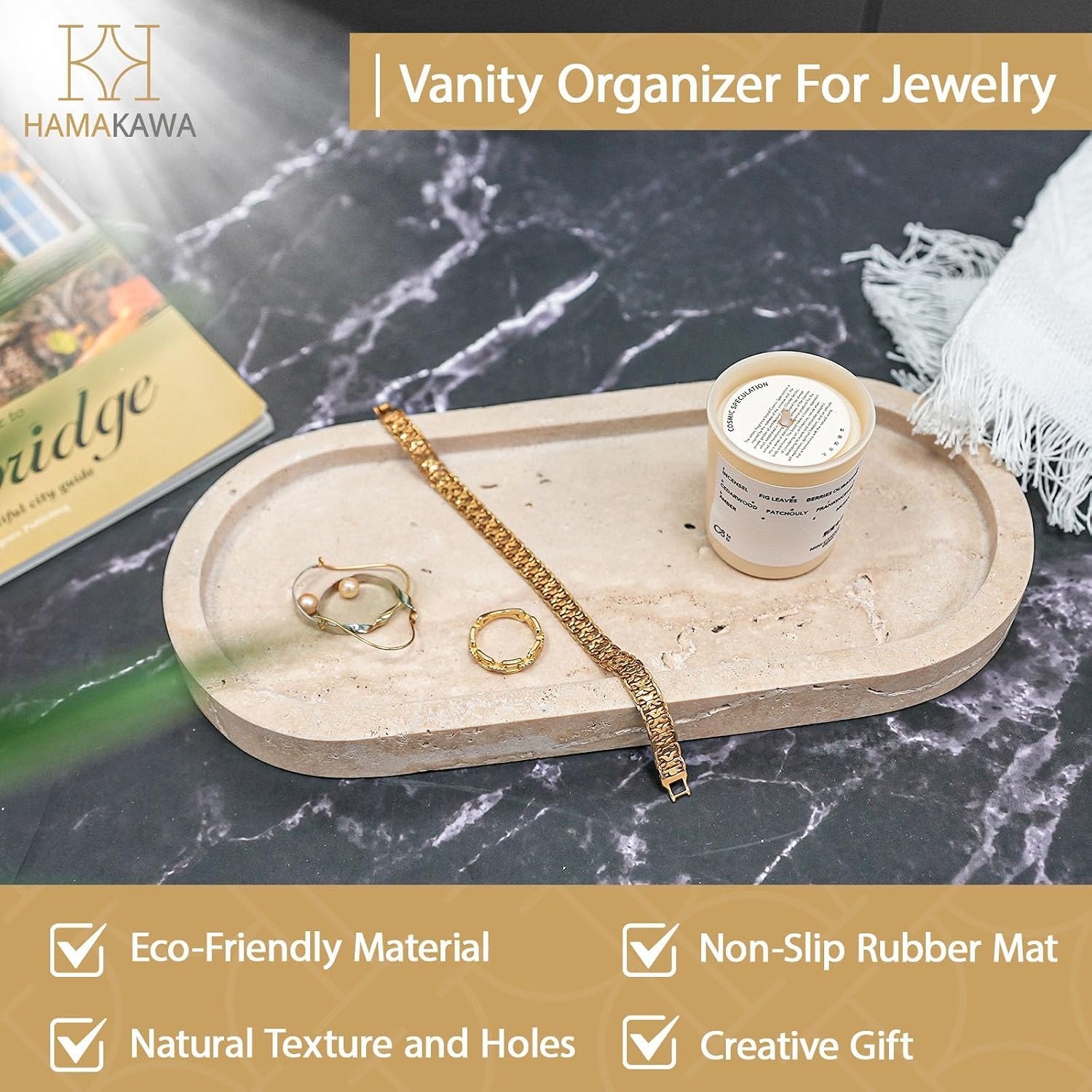
Rubber pads on the base add the second half of the equation. They grip the surface and they keep the stone from touching your furniture directly, which matters on timber and on glass shelving. When you move the tray, lift it. Dragging a stone base across a surface is how pads get torn off and finishes get scuffed.
The practical result is a tray you can use without thinking about it. Drop keys in from a step away, push a bottle across it, knock it with an elbow. It stays put.
Where it works around the house
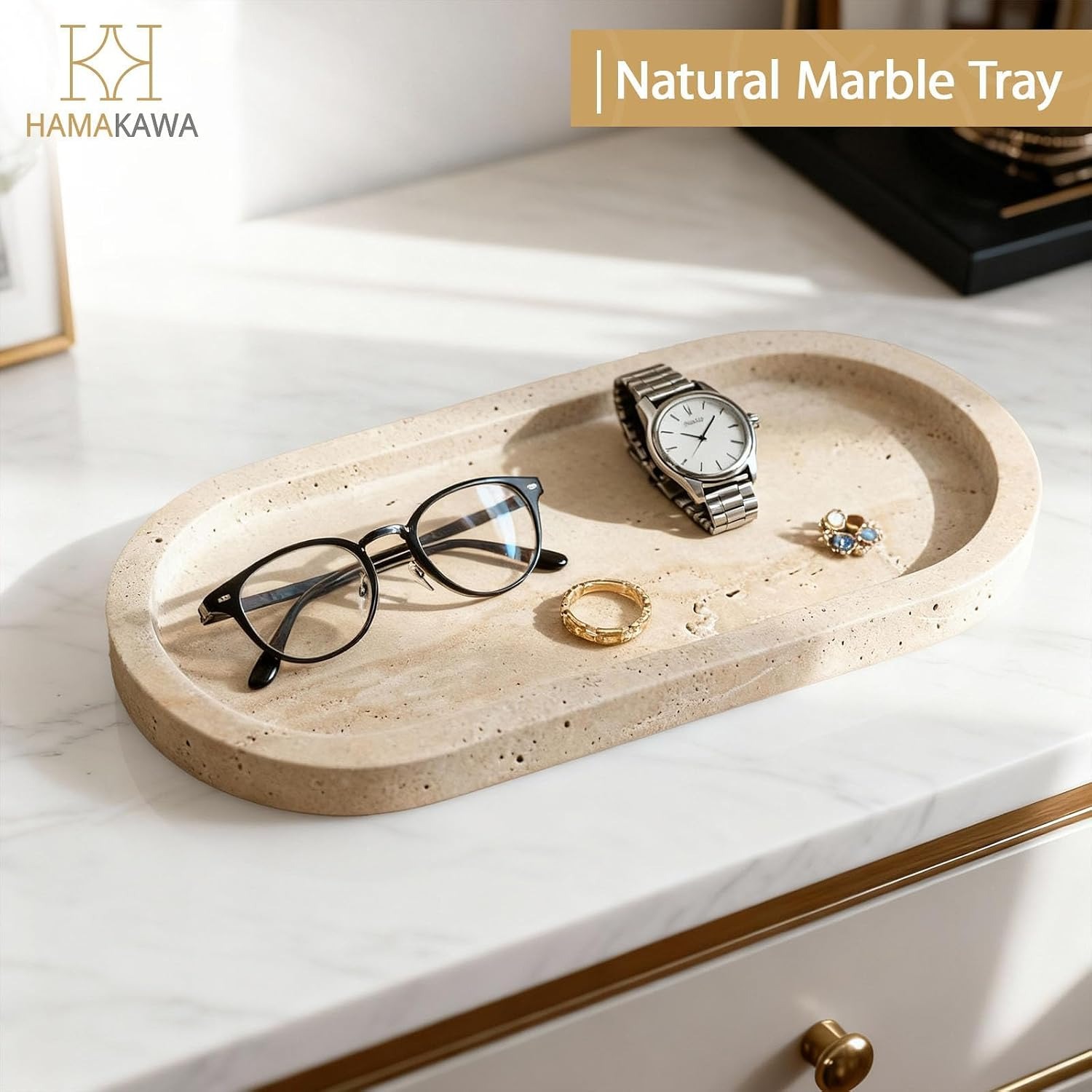
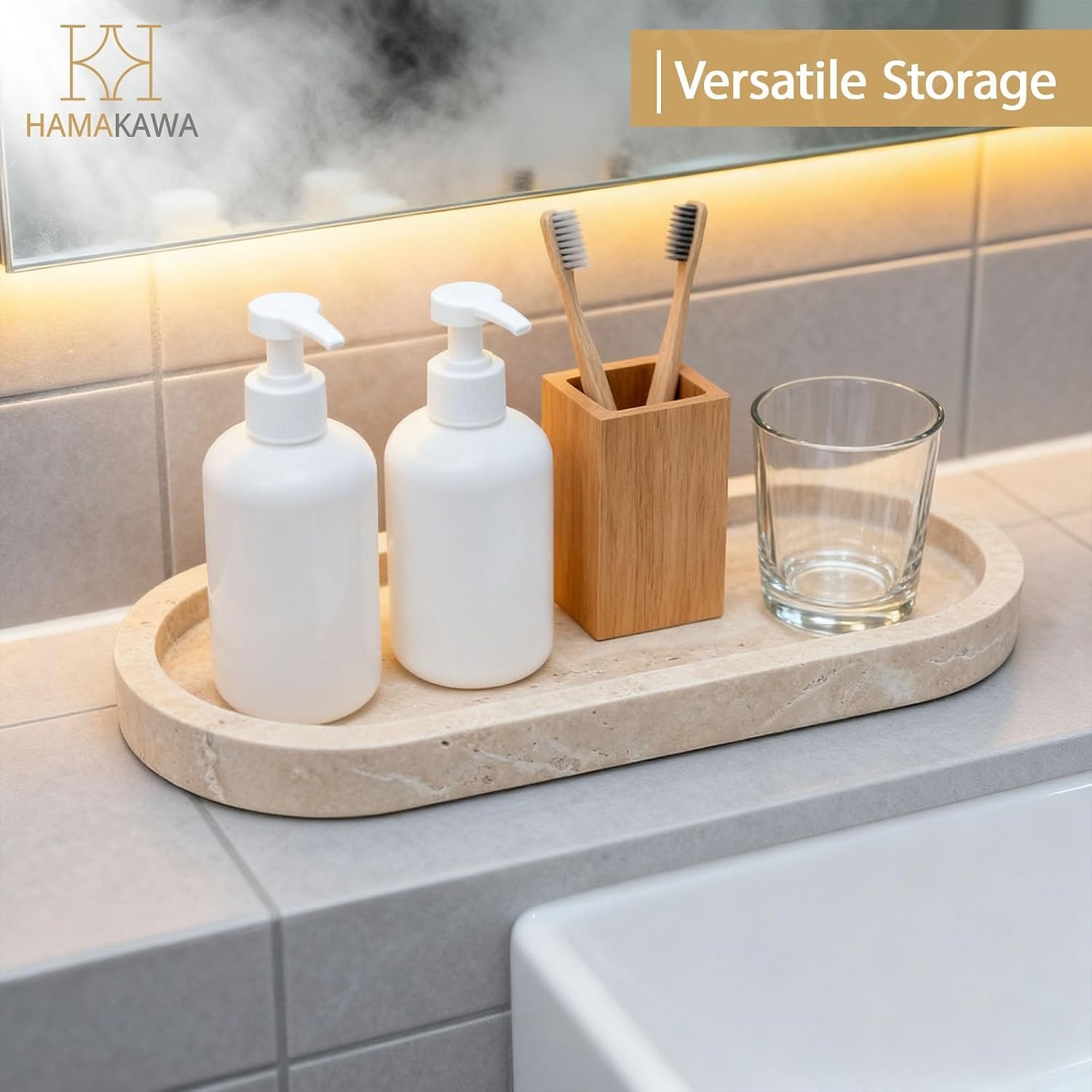
The obvious spot is the bathroom. A natural stone bathroom tray holding skincare, a soap dish and a small bottle of oil makes a bench look considered even when the rest of the room is mid-renovation.
The bedroom dresser is the second home. Perfume, jewellery, a watch, a small dish for coins. This is where a dresser tray for perfume earns its keep, because it stops bottles from tipping and rolling when you open a drawer below.
In the kitchen it works beside the sink for hand soap and a ring dish, or near the stove to corral salt, pepper and a small oil bottle. Just keep in mind the porosity, so wipe up oil rather than leaving a slick on it.
In the entry it becomes a key tray with a rim, which beats a bowl because you can see what is in it at a glance. And on a coffee table it can anchor a candle and a book of matches without looking like storage.
Buying natural stone online, what to check
Three things trip people up.
The first is expecting uniformity. Photography shows one specific piece. Yours will differ in veining and pore pattern. Read that as a feature, not a risk.
The second is sealing and maintenance anxiety. People hear porous and assume a weekly ritual. In reality, a damp cloth handles ninety percent of what a tray goes through. The rest is just common sense, meaning do not leave perfume puddled on it and do not clean it with lemon spray.
The third is thickness. Thin stone trays chip at the edges. This one runs 2 cm high overall, with the edges polished smooth and burr-free so there is no raw ridge to catch and crack.
Looking after it
Wipe with a soft damp cloth. Dry it after. That is the routine.
Skip abrasive pads, bleach and anything acidic. Vinegar, lemon and some bathroom descalers can etch the surface of calcium-based stone, leaving a dull patch that does not polish out easily.
Spills need attention rather than panic. Blot perfume, oil or makeup promptly and the stone will be fine. Leave it overnight and you may get a faint mark. Travertine is forgiving, not invincible.
If the rubber pads ever lift at a corner, a dab of clear adhesive will put them back. Keep the tray off hot surfaces directly from an oven, and let candle jars cool before you move them.
As a gift
Stone trays are quietly one of the best low-risk gifts going. They do not need to match a colour scheme. They do not require the recipient to have a particular taste. They are useful immediately, and they look like you spent more thought than you did.
Weddings, housewarmings, a thank you for someone who put you up for a weekend. A beige travertine tray slots into almost any home, and because it carries natural variation, it reads as a considered object rather than something grabbed off a shelf.
The short version
If your vanity is a scatter of bottles and small metal things, a tray solves it in about ten seconds of effort. This one is real travertine, 25 by 11.5 by 2 cm, 0.8 kg, with smoothed edges and rubber pads so it stays where you put it.
It is narrow enough for a real bathroom bench, heavy enough not to wander, and easy enough to clean that you will actually keep it clean. Expect natural variation in the stone, treat spills promptly, and it will sit there looking good for years.